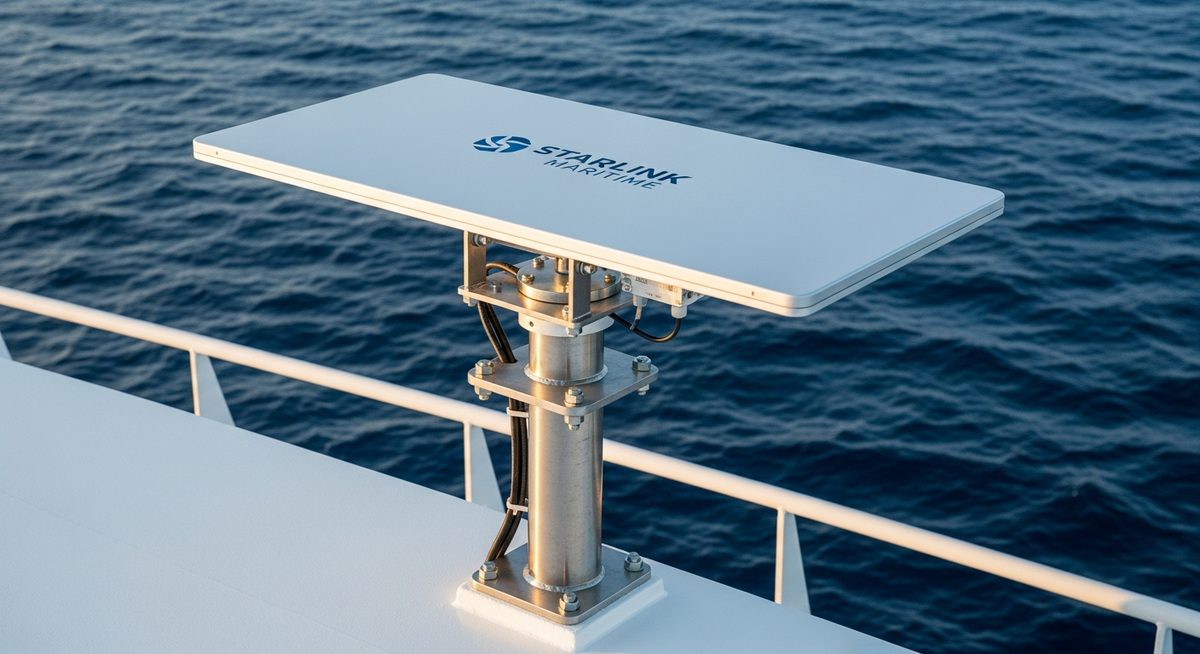
Connectivity was the number one operational complaint across our fleet. Vessels had unreliable cell-only connections or no internet access at all. Crews carried personal phones with cell service but could not access a single business system from the vessel. Shore-side offices in locations like Puerto Rico relied on wireless ISPs with zero backup. When the connection dropped, the operation went dark.
I deployed 41 Starlink units across vessels and offices, replaced VSAT entirely, and built an enterprise-grade failover architecture on the water. Here is what I learned.
Start with a proof of concept, not a rollout
We did not go fleet-wide on day one. I ran a proof of concept at our California offices first. This was intentional. Testing on a shore-side facility let us evaluate Starlink's performance, reliability, and integration characteristics without the added complexity of a moving vessel.
The POC confirmed what we needed to know: the service was viable for our use case. It also revealed integration details that would have been painful to discover mid-rollout. Never skip the POC, even when the technology looks like an obvious win. Especially when it does.
Enterprise-grade means failover
Starlink alone is a connectivity source, not an enterprise solution. The enterprise part is what you build around it.
I spec'd and selected Cradlepoint routers and modems for active/active smart WAN failover. Not active/passive, where one connection sits idle until the primary fails. Active/active, where both connections carry traffic simultaneously and either can absorb the full load if the other drops. On a vessel, where connectivity conditions change constantly, active/active is the difference between a blip and an outage.
The architecture: Starlink as the primary high-bandwidth link, cellular as the failover and secondary path. Smart WAN policies route traffic based on application priority, available bandwidth, and link health. Business-critical applications get routed to the most reliable path. Guest WiFi fills in around it.
Negotiate before you scale
When you are deploying 41 units across a fleet, you are not a retail customer anymore. I negotiated a $500 per-unit cost reduction on the Cradlepoint hardware before we scaled. On 41 units, that adds up. If you are buying at volume, talk pricing before you order. Not after.
Deploy it yourself, at least at first
I performed many of the installations personally and oversaw the remaining deployments across my team. There is a reason for that. When the person designing the architecture is also the one installing it on the first vessels, you catch problems that drawings miss. Mounting positions that look good on paper but do not account for cable runs. Antenna placements that are technically correct but operationally impractical. The gap between design and reality closes fastest when you close it yourself.
The results
Vessels went from no usable connectivity to near-complete coverage on the water. For the first time, we could run domain-joined business applications, provide guest WiFi, and enable operational monitoring systems from the vessel. VSAT was phased out entirely. The systems that used to require satellite uplinks at a fraction of the performance were replaced by Starlink at better speeds, better reliability, and lower ongoing cost.
Shore-side offices with unreliable connectivity got the same treatment. The same Starlink plus Cradlepoint architecture. The same failover design. The same result: reliable connectivity where it did not exist before.
Things the slide deck does not cover
The dish is the easy part. Plan for the vessel environment: moving platforms, vibration, salt air, limited physical access for maintenance. Your hardware selection and mounting approach need to account for all of it. Active/active beats active/passive on the water, because a failover architecture that requires detecting failure before switching is too slow when conditions change every minute. And if you are deploying more than 10 units, you have leverage. Use it.
Maritime connectivity has been the hardest problem in fleet IT for years. Starlink changed what is possible. The technology is only as good as the architecture you build around it. The architecture is only as good as the team that executes it.
Adam Cooper is a Technical Director writing about distributed IT operations, maritime technology, and AI in production environments. Connect on LinkedIn or Send Email.